Preprint · 2025
Learning from Demonstration & Reinforcement LearningMulti-Fidelity Policy Gradient Algorithms
Xinjie Liu, Cyrus Neary, Kushagra Gupta, Christian Ellis, Ufuk Topcu, David Fridovich-Keil
arXiv preprint arXiv:2503.05696, 2025
Abstract
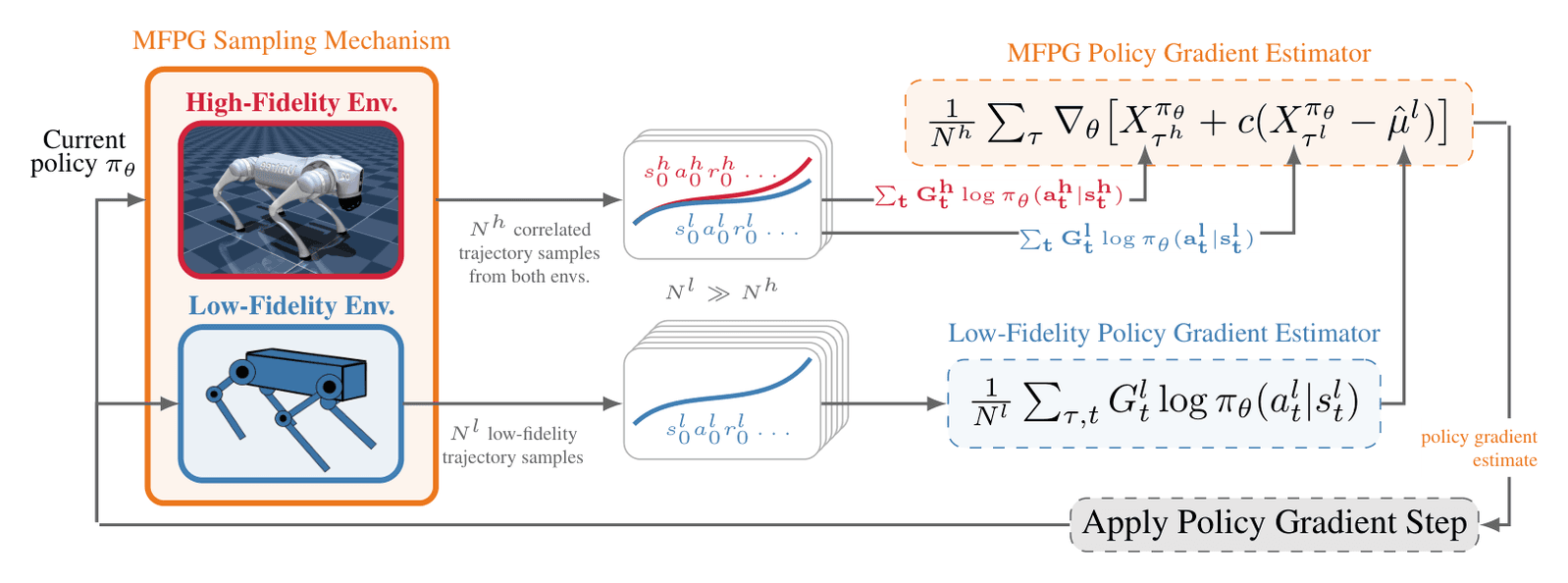
Many reinforcement learning (RL) algorithms require large amounts of data, prohibiting their use in applications where frequent interactions with operational systems are infeasible, or high-fidelity simulations are expensive or unavailable. Meanwhile, low-fidelity simulators—such as reduced-order models, heuristic reward functions, or generative world models—can cheaply provide useful data for RL training, even if they are too coarse for direct sim-to-real transfer. We propose multi-fidelity policy gradients (MFPGs), an RL framework that mixes a small amount of data from the target environment with a large volume of low-fidelity simulation data to form unbiased, reduced-variance estimators (control variates) for on-policy policy gradients. We instantiate the framework by developing multi-fidelity variants of two policy gradient algorithms: REINFORCE and proximal policy optimization. Experimental results across a suite of simulated robotics benchmark problems demonstrate that when target-environment samples are limited, MFPG achieves up to 3.9× higher reward and improves training stability when compared to baselines that only use high-fidelity data. Moreover, even when the baselines are given more high-fidelity samples—up to 10× as many interactions with the target environment—MFPG continues to match or outperform them. Finally, we observe that MFPG is capable of training effective policies even when the low-fidelity environment is drastically different from the target environment. MFPG thus not only offers a novel paradigm for efficient sim-to-real transfer but also provides a principled approach to managing the trade-off between policy performance and data collection costs.
Cite
@misc{liu2025multi,
  title = {{Multi-Fidelity Policy Gradient Algorithms}},
  author = {Xinjie Liu and Cyrus Neary and Kushagra Gupta and Christian Ellis and Ufuk Topcu and David Fridovich-Keil},
  year = {2025},
  eprint = {2503.05696},
  archivePrefix = {arXiv}
}